Accommodation Hatch Calendar
The Fly Fishing in the Deep South;
The Mataura River and surrounding area is mecca for the dry fly man, with many anglers returning year after year for another fix, make sure you include it on your list of places you must fish!
New Zealand's Lack of Mayfly Fishing?
Nothing is
more exciting to fly fishers than the prospect of matching the hatch. While New
Zealand is famous for its trout, it is not known for this type of fly fishing.
In fact many visiting anglers go throughout their entire trip without seeing a
mayfly, let alone a hatch. Experts say, this is because our mayflies are
characterised by what is known as 'asynchronous' emergence. 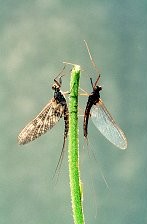 This means
they have evolved to hatch in small numbers over an extended time period and are
therefore less obvious to both the angler and the trout. Contrast this with the
precise, synchronised Northern Hemisphere hatches. For example we know that on
the Henry's Fork the brown drakes will emerge in the evening around the middle
of June, whilst the green drakes are daytime hatchers during the later part of
June.
This means
they have evolved to hatch in small numbers over an extended time period and are
therefore less obvious to both the angler and the trout. Contrast this with the
precise, synchronised Northern Hemisphere hatches. For example we know that on
the Henry's Fork the brown drakes will emerge in the evening around the middle
of June, whilst the green drakes are daytime hatchers during the later part of
June.
The Mataura and Deleatidium Mayflies - a Special
Relationship
The New Zealand fishery where anglers
are most likely to find mass daytime hatches is the Mataura. Why is this? It's
thought that this unique phenomenon is due to a combination of factors. The two
most important being the abundance of mayfly nymphs and the form of the river.
Interestingly, visiting anglers often comment that the Mataura reminds them of
the hatch rivers of the American mid west such as the Big Horn or the San Juan.
What the Mataura shares with these rivers is a high proportion of shallow,
rippled water of moderate velocity. This combined with the abundant mayfly
population induces a high level of surface and mid water feeding from the
resident trout.
But there's still more for the dry fly angler. The Mataura has huge populations of net building caddis (Aoteasphyche colonica ) and chironomid midges. Both can provide intense surface action. A recent study summed up this special fishery, "the combination of abundant mayflies, shallow swift - flowing water and rising trout- which is not particularly common - is the essential pre requisite of high quality nymph and dry fly fishing".
Massive Trout Population
The Mataura river is an
almost continuous succession of ripples, glides and pools. In short the ideal
trout habitat. Whilst no figures exist for trout per kilometre, experts think 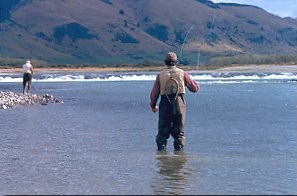 that certain parts possess an enormous stock of
fish. An estimate based on riverside observations is considered impractical
because there are simply too many trout to count.
that certain parts possess an enormous stock of
fish. An estimate based on riverside observations is considered impractical
because there are simply too many trout to count.
Average Size of Mataura Trout
The Mataura contains
only wild brown trout. And as you'd expect from a New Zealand fishery, there are
no tiddlers. They average about 2 and a half pounds. That's about 18 inches of
wild, hard fighting brown trout. Naturally with such a large trout population
there's always the chance to hook something much bigger, and every year a number
of fish over 10 pounds are taken. Most anglers, however, are happy with casting
to 2 to 3 pound fish, with the odd 4 and a half to 5 pound fish (twenty inches)
thrown in to liven proceedings.
Fish Hooked per Day
Given the variables of fly
fishing it's hard to quantify. On good hatch days, anglers can expect to cast
to countless rising fish. If the mayflies are co-operating a basic angler, 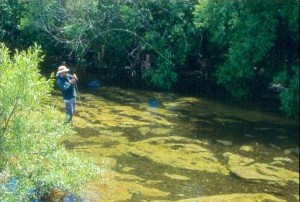 who
correctly matches the hatch, can expect to hook upwards of 10 trout per day. On
such days competent fly casters can expect tallies in the high teens.
who
correctly matches the hatch, can expect to hook upwards of 10 trout per day. On
such days competent fly casters can expect tallies in the high teens.
Suitable for All
It's an easily accessed fishery to
suit all levels of fitness. For those less mobile, most access points enable us
to drive right beside the river. Its banks are open, giving plenty of casting
room and its shingle bottom presents easy wading. During normal and low flows it
is easy to manoeuvre to cast and to prospect likely water.
Variety of Fly Fishing Nearby
Within 90 minutes of
leaving the Mataura you can reach the beech forests and mountains of Fiordland.
Rivers running into the nearby lakes contain rainbows as well as browns. Whilst
you are unlikely to strike dense hatches, there is a wide variety of trout
stream insects present. Consequently there's always the chance to come upon a
hatch of Ameletopsis (sulphur duns), spot a large Oniscigaster dun or perhaps witness a fall of Nesameletus spinners. This is a beautiful area and the trout, particularly the
rainbows, tend to be free rising in nature. Fish may not be as prolific as on
the Mataura, but they are bigger. Rainbows average around four pounds, that's
over 20 inches, and the browns are larger